The Girl I Am, The Change I Lead: What Data Says About Nigeria’s Girls
Published on October 13, 2025
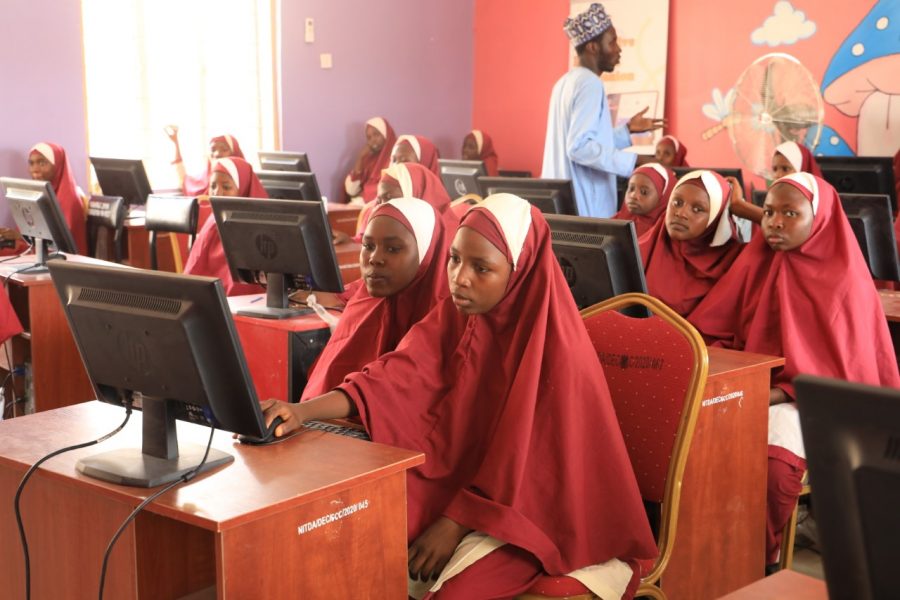
On the street corners in Yobe State near her local school, 13-year-old Aisha Salisu, who hawks snacks each morning, has seen children entering the small classrooms in the morning for years and has always wondered what was going on inside the small classrooms.
One day, she mustered the courage to follow a group of children into a nearby classroom, where she sat down to listen. She had no uniform, no books, and was not enrolled; yet she wasn’t deterred by the whispers or the confusion. She raised her hand when she didn’t understand, and asked questions when lessons didn’t make sense. Her persistence turned heads, and eventually, with help from the local Mothers’ Association, Aisha entered formal school, leaving the street life behind and stepping into the light of learning.
Her experience is not unique; millions of girls face similar obstacles, and their stories remind us why it is so important to pay attention and take action.
Every October 11 has been a key global moment the world observes for the International Day of the Girl Child since the United Nations adopted it as International Day of the Girl in December 2011 to celebrate the power of girls, highlight the barriers they face, and amplify their rights and leadership.
This year's theme, “The Girl I Am, The Change I Lead: Girls on the Frontlines of Crisis,” celebrates girls’ resilience amid conflict, displacement, and social change.
Girls in Crisis: Global Reality, Nigerian Urgency
Globally, approximately 120 million girls are still out of school, according to UNICEF report. Girls in emergencies are disadvantaged at all stages of education and are more likely to be out-of-school than in non-emergency settings. Girls are also struggling to learn: in fact, it is estimated that by 2030, one in five girls in crisis-affected countries will not be able to read a simple sentence. In Nigeria, this pattern persists: according to Dataphyte’s 2025 Gender in Nigeria Report,
34.3% of women aged 15–49 have no access to formal education, compared to 22.5% of men.
Only 13.7% of women have an education beyond secondary school.
This education gap directly affects decision-making. Just 28.8% of currently married women can make informed decisions about their sexual and reproductive health, compared to over 57% among those with higher education.
Child Marriage, Violence, and the Cost of Silence
Child marriage remains a major barrier to girls’ futures. Dataphyte’s report notes that 12.5% of women aged 15–49 married before their 15th birthday, compared to just 1.9% of men. These early unions cut short education and increased maternal health risks.
Violence is another enduring shadow:
65% of women reported experiencing rape in 2022. A sharp rise from 29% in 2020.
77.3% of trafficked persons in 2022 were women, with those aged 16–25 being the most vulnerable.
29.3% of women believe wife-beating can be justified under certain conditions — a reflection of normalized gender violence that still shapes many homes.
This is not just data, it’s a painful truth and reality about how Nigerian girls are growing up in a society where their safety, choices, and dignity remain under siege.
Digital Divide and Media Literacy: The New Barrier
Girls’ access to information is said to determine their access to opportunities in a digital world. Yet, Dataphyte’s findings show a stark gender digital gap:
Only 13.4% of women have ever used a computer, compared to 21.8% of men.
Just 58.2% of women have ever used a mobile phone, compared to 73.4% of men.
Millions of Nigerian girls are excluded from skills and spaces that define the future economy due to a lack of digital literacy and connectivity. This is a challenge that deepens inequality in education, health, and civic participation.
Health, Autonomy, and Reproductive Rights
Teenage pregnancy remains high, with 15% of girls aged 15–19 having been pregnant, 11% already mothers, and 4% currently pregnant as of 2022. Regional disparities show the Northwest leading with 22.5%, underscoring persistent cultural and economic factors.
Moreover, female genital mutilation (FGM), though declining, still affects 15.1% of women aged 15–49. The practice remains most common in northwest Nigeria (14.1%), and 35.1% of girls who underwent FGM had mothers who also experienced it, showing intergenerational transmission of harmful practices.
Work and Economic Participation
Despite progress, the labour force mirrors gender imbalance:
Female unemployment stands at 6.2%, compared to 4.3% for men.
87.9% of women are self-employed, largely in informal sectors, versus 79.9% of men.
Only 12.1% of women are in wage employment.
Even in security roles, representation remains low. Only 7.6% of senior police officers and 30.3% of female NSCDC officers occupy leadership positions.
It is said that when women and girls are excluded from equitable education, employment, and leadership, Nigeria loses not just potential, but progress.
Breaking the Cycle: Why Data and Action Matter
The Gender in Nigeria 2025 Report reinforces UNICEF’s position that closing gender gaps is not merely a social ideal. It's an economic imperative. Educated, empowered girls fuel innovation, peacebuilding, and sustainable growth.
For every percentage increase in girls’ primary education, there’s a measurable rise in GDP per capita and a decline in maternal and infant mortality rates. The evidence is clear: investing in girls transforms nations.
What Nigeria Must Do
Invest in girls’ education and digital access, especially in rural and conflict-affected areas.
Enforce laws against child marriage, trafficking, and gender-based violence, ensuring proper survivor support systems.
Bridge the digital divide through programs targeting girls’ access to mobile phones, the internet, and coding/AI literacy.
Empower girl-led initiatives. Let girls lead local change through safe spaces and mentorship.
Use data for accountability. Open gender data, such as Dataphyte’s reports, should inform policy and budget decisions.
The Girl I Am, The Change I Lead
When Nigerian girls like Aisha’s voice are not silenced by fear, Zainab can code her first app, and Chioma can complete her degree, Nigeria will rise.
This International Day of the Girl Child, Dataphyte Foundation joins UNICEF in reaffirming one truth: girls are not the future, they are the present, shaping the world now.
Their power deserves not pity, but partnership. Their data demands not sympathy, but strategy.
Download the full Dataphyte’s Gender in Nigeria 2025 report here
Citation
Dataphyte Foundation (2025). “The Girl I Am, The Change I Lead: What Data Says About Nigeria’s Girls.” Dataphyte Foundation. Available at: /gender/the-girl-i-am-the-change-i-lead-what-data-says-about-nigerias-girls
Blog
Strengthening Women Economic Justice in West and Central Africa: Dataphyte Foundation and Christian Aid Hold Inception Workshop