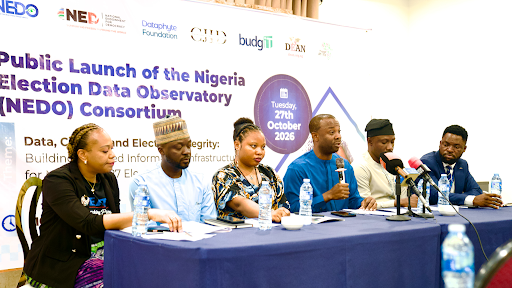
Independent election observation plays an important role in providing citizens with information about how elections are conducted. But in Nigeria, observation efforts have often operated through separate networks, tools and datasets. This fragmented coordination limits the reach of independent observation and makes it harder to connect evidence gathered by different civic actors for broader electoral accountability and integrity advocacy.
Ahead of the 2027 General Elections, the Nigeria Election Data Observatory (NEDO) Consortium is working to address this gap through a coordinated election observation and shared data infrastructure.
Led by Dataphyte Foundation, the consortium comprises Yiaga Africa, BudgIT Foundation, the Centre for Journalism Innovation and Development (CJID) and DEAN Initiative, with funding from the National Endowment for Democracy (NED). The five organisations will combine their respective capacities in election observation, civic technology, research, data analysis, media and civic engagement within a shared system for collecting, verifying, analysing and communicating election information.
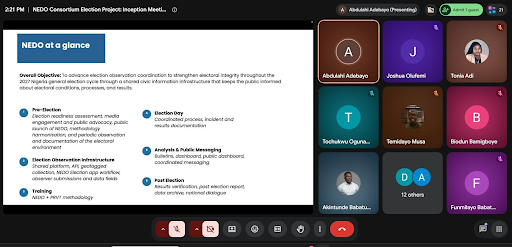
In September, Dataphyte Foundation coordinated the consortium’s inception meeting, marking the start of joint implementation ahead of the 2027 electoral cycle.
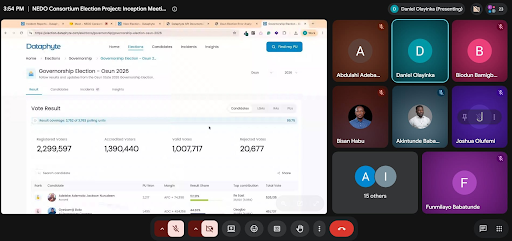
The consortium plans to deploy approximately 1,400 observers, with a goal of reaching 1,400 unique polling units across the country. This coordinated deployment is intended to extend the reach of independent observation while creating a common evidence base that partners can use during and after the electoral cycle.
Central to the shared infrastructure is the NEDO election observation app. The app will enable observers to submit information directly from the field, including updates on election administration, incidents, election results and supporting photo, audio and video evidence. It is also designed to function in low-network environments, an important consideration for observation across locations with varying levels of connectivity.
Built-in checks will help identify inconsistencies in information submitted from the field, providing another layer of scrutiny as observation data is collected.
Information submitted through the app will feed into a shared data pool available to consortium partners and other civic and media actors in the ecosystem. Documented results will also be compared with polling-unit results published on INEC’s Result Viewing Portal (IReV), allowing partners to examine differences between information gathered independently from the field and records published through the official results platform.
The inception meeting focused on developing common data-quality standards and a harmonising observation methodology. These standards will provide a common framework for how information is collected, verified and analysed across the consortium. The intention is to make evidence from different observation workstreams useful for collective public communication.
Beyond election-day observation and result tracking, evidence generated through NEDO will inform joint research, regional policy briefs, periodic election insights, media engagement and public communication before, during and after the elections.
Building towards 2027
The September inception meeting established the initial responsibilities, systems and standards through which Dataphyte Foundation, Yiaga Africa, BudgIT Foundation, CJID and DEAN Initiative will work ahead of the 2027 General Elections.
The next phase will move this shared infrastructure from coordination and planning into implementation as the NEDO Consortium prepares for its formal launch.
By connecting observation networks, technology, data and institutional expertise, NEDO is working towards a wider and more coordinated model of independent election observation, one capable of producing evidence that can contribute to electoral transparency, accountability and integrity across Nigeria’s 2027 electoral cycle.
Citation
Dataphyte Foundation (2026). “NEDO: Building a Shared Election Data Infrastructure for Nigeria’s 2027 Elections.” Dataphyte Foundation. Available at: /election/nedo-building-a-shared-election-data-infrastructure-for-nigerias-2027-elections
Blog

Strengthening Women Economic Justice in West and Central Africa: Dataphyte Foundation and Christian Aid Hold Inception Workshop